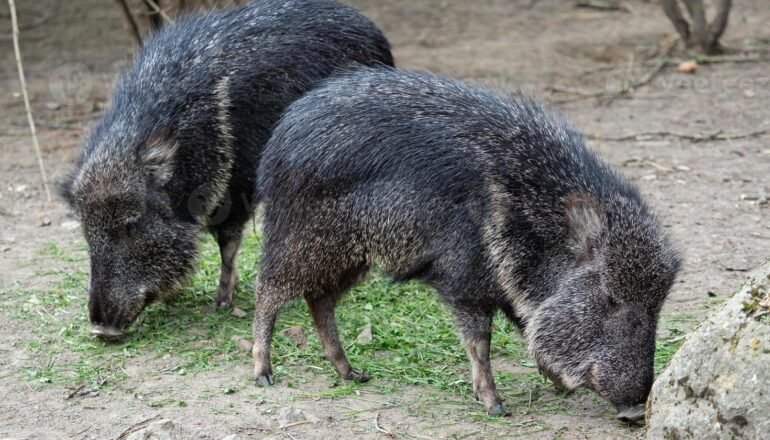
While trekking through the dry forests, humid jungles, or Andean foothills of Colombia, you might hear the crunching of dry leaves and spot a herd of animals that, at first glance, look like wild pigs. These are Peccaries, known locally as Tatabros or Saínos.
At Ecoturismo Colombia, we want to introduce you to this tireless worker of nature, a species fundamentally essential to the health of our ecosystems.
They are NOT Wild Pigs
Although they strongly resemble boars or domestic pigs, they belong to a completely different evolutionary family (Tayassuidae). Unlike wild pigs, peccaries have straight (not curved) tusks and a distinct gland on their back that secretes a strong musky odor used to identify members of their herd.
The Soil Engineers
The peccary has a vital mission in the forest: “bioturbation.” With their strong snouts, they constantly root and churn the soil in search of seeds, roots, tubers, and insects. This “plowing” process aerates the earth, allowing buried seeds to successfully germinate. Furthermore, by traveling in large herds (sometimes dozens of individuals), they widely disperse nutrients and seeds across the entire forest floor.
Frequently Asked Questions (FAQ)
- Are they dangerous to humans? Generally, they are skittish and will flee upon detecting humans. However, if a herd feels cornered or is defending their young, they can defend themselves fiercely by aggressively clacking their sharp tusks.
- Are they endangered? Some subspecies are, primarily due to overhunting and the alarming deforestation of their habitats for agricultural expansion.
- Where can they be spotted? In natural reserves across the Eastern Plains (Llanos), the Amazon, and the Sierra Nevada de Santa Marta, often captured by motion-sensor camera traps.
💬 A Green Reflection: Every animal plays a vital role in the web of life. What other species do you consider a “gardener” of our forests?